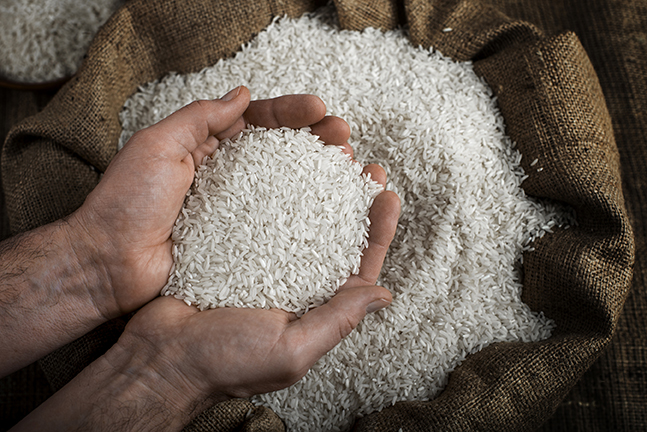
The global rice market in 2026 faces a challenging outlook, fraught with numerous obstacles stemming from geopolitical issues and volatile climate conditions caused by global warming. These factors impact agricultural production, particularly rice, a key agricultural commodity for Thailand. The global rice market in 2026 is projected to experience increased competition, both in terms of pricing and the continued stability of importing markets, with no signs of increased imports
Compounding the challenge is the surplus global rice production figures, which the U.S. Department of Agriculture (USDA) estimates at 540-560 million tons this year, similar to last year’s volume. Furthermore, India’s rice export policies, coupled with India’s role as the primary exporter (accounting for approximately 40% of global rice exports) and Thailand’s 15-16% share, present significant challenges for Thai rice exports in 2026.
Ms. Arada Fuangthong, Director-General of the Department of International Trade (DIT), revealed to “Prachachat Business” the plan for rice exports and maintaining existing rice markets while expanding into potential markets. She stated that the DIT is ready to push forward with plans to boost Thai rice exports in 2026, as well as plans for exporting other key agricultural products such as cassava and promoting border trade next year
The export target for 2026 has been lowered to 7 million tons.
Recently, the Department of International Trade, in collaboration with the Thai Rice Exporters Association, assessed the overall global rice market for 2026. They predicted continued competition due to high global rice production and India’s release of rice stocks, which is putting downward pressure on market prices. Therefore, they discussed and outlined plans to maintain existing markets and expand into potential markets, forecasting Thai rice exports to reach 7 million tons in 2026.
The target for rice exports in 2026 has been lowered to 7 million tons, down from the original target of 7.5 million tons for 2025. However, total rice exports for the year are expected to reach 8 million tons. This downward target is due to intense competition in the global rice market from increased rice production, the anticipated release of large rice stocks from India, declining demand from key trading partners such as Indonesia due to geopolitical conflicts affecting transportation costs, and the appreciation of the Thai baht, which reduces the competitiveness of Thai rice prices compared to competitors. These effects have continued from last year to the present
However, at the same time, there is also a positive impact on rice imports. Concerns about geopolitical conflicts may cause some rice importing countries to stockpile rice as a reserve to increase food security, which could present a significant opportunity for rice exports as well.
Plan to promote Thai rice to the global market.
To ensure the continued competitiveness of Thai rice exports, the Department of International Trade has outlined a plan comprising: 1. Continuously promoting and negotiating rice sales, including a government-to-government (G2G) rice trade agreement with the Chinese government for 500,000 tons. Currently, an agreement has been reached for 100,000 tons, with price negotiations underway. A conclusion is expected after the New Year, with delivery commencing immediately upon agreement, and completion scheduled for March 2026. The remaining amount will be negotiated for completion within 2026.
This also includes following up on the implementation of the memorandum of understanding on rice trade with the Singaporean government, which agreed on a maximum rice trade volume of 100,000 tons over a five-year period. Preparations have been made, and discussions will begin in January 2026.
- Accelerate the expansion of white rice and parboiled rice markets in potential markets such as Iraq, Saudi Arabia, the Middle East, and Africa. Expand markets for refined rice such as Germany, Switzerland, and the United States. Strengthen relationships and build trust with key trading partners such as Hong Kong, China, the United States, and Canada.
- Strengthening relationships and building trust with key trading partners to expand the market for Thai rice, such as Hong Kong, China, the United States, and Canada, in order to strengthen trade cooperation and increase export opportunities.
- The department will continue to promote Thai rice through international trade fairs, connecting rice importers and exporters by bringing small-scale producers to participate in sales negotiations with importers at events such as BIOFACH (Germany), February 10-13, 2026; Natural Products Expo West (USA), March 3-6, 2026; and Thaifex-Anuga Asia (Thailand), May 26-30, 2026. In addition, the department plans to promote Thai rice at annual trade fairs such as Gulfood (UAE), Foodex Japan (Japan), SIAL Canada (Canada), Summer Fancy Food Show (USA), Fine Food (Australia), SIAL Paris (France), China-ASEAN Expo, and China International Import Expo (CIIE) (China).
- Strengthening trade relations with key trading partners to build confidence and boost Thai rice exports, including Hong Kong (January 17-19, 2026), Switzerland and Germany (February 2026). There are also plans to strengthen rice trade relations with China, the United States, and Canada.
- Promoting and publicizing Thai rice through online channels to create awareness and stimulate demand for Thai rice on a wider scale, including among younger generations. This can be achieved by organizing Thai rice consumption campaigns in collaboration with restaurants or well-known key influencers.
Regarding the rice price situation, data from the Department of Internal Trade indicates an improvement. Currently, the price of white paddy rice is above 8,000 baht per ton, while jasmine rice is at 14,700-16,100 baht per ton, and in some areas reaches 18,000 baht per ton. Pathum Thani rice is at 8,000-8,300 baht per ton, ordinary rice is at 6,300-7,200 baht per ton, and glutinous rice is at 7,000-10,000 baht per ton. Jasmine rice prices have increased the most, by up to 1,000 baht per ton, and ordinary rice prices have increased by up to 400 baht per ton.
Expanding into the animal feed market.
Regarding the plan to promote Thai cassava exports, a product that the department prioritizes, exports are expected to continue growing in 2026. This is supported by demand from overseas markets, particularly China (for the alcohol and animal feed industries) and the Middle East. However, challenges remain, including declining production volumes and the impact of border conflicts between Thailand and Cambodia. Therefore, strategies are needed to ensure the continued growth of Thai cassava exports.
The department plans to expand into new, potential markets such as the United Arab Emirates, Japan, the European Union, North America, and the Philippines, targeting the animal feed, food, adhesive, and paper industries. In addition, the department plans to organize delegations from the public and private sectors to conduct market expansion activities and participate in trade fairs abroad to boost cassava exports to promising markets.
For 2026, the department has set a target of 1.9 trillion baht for border and transit trade, an increase of 2.7%. Plans to boost trade include: holding joint meetings between central and regional government and private sectors to address obstacles and promote border and transit trade in Sa Kaeo, Nong Khai, Mukdahan, Nakhon Phanom, Tak, Chiang Rai, Kanchanaburi, Songkhla, and Narathiwat; implementing projects to strengthen border entrepreneurs along the four regional economic corridors in Khon Kaen, Phitsanulok, Nakhon Si Thammarat, and Chanthaburi; organizing two border trade fairs in special economic zones; and holding meetings to promote cooperation in border trade and investment under the IMT-GI, ACMECS, and GMS frameworks to facilitate trade.
Read the original news article here : https://www.prachachat.net/economy/news-1946704